An 8-day loop from Newcastle connecting Hadrian's Wall, Alnwick Castle, the dramatic coast at Bamburgh and Holy Island, and Berwick-upon-Tweed, with no single leg over 90 minutes.
Northumberland is one of England's most quietly extraordinary regions: a sparsely populated county between the Pennines and the North Sea, with more castles per square mile than almost anywhere else in the country. This Northumberland castles and coast road trip itinerary covers the best of it in eight days, looping from Newcastle upon Tyne to the Roman frontier, north through medieval castle country to one of Britain's finest stretches of coastline, and back through England's northernmost town.
The driving is relaxed throughout. No leg takes longer than 90 minutes, total road distance is under 300 km, and the route uses well-maintained A-roads and quiet coastal lanes with no motorway sections once you leave the Newcastle outskirts.
The loop starts and ends in Newcastle upon Tyne. Day one is based in the city, giving time to settle in before the proper driving begins. Days two and three are spent in Hexham, the natural base for a day on Hadrian's Wall. From there the route turns north on the A68 and A697 to Alnwick, then drops onto the coast at Bamburgh for a two-night stay. Holy Island is a day trip from Bamburgh rather than an overnight. The final stop before returning to Newcastle is Berwick-upon-Tweed, a satisfying border town with its own distinct character.
This is a mid-budget, moderate-activity route for travellers who want to mix Roman history with medieval drama and coastal scenery, without committing to remote single-track roads. Families enjoy the Harry Potter connection at Alnwick and the easy beach at Bamburgh. Couples and solo travellers do well at Hexham, which has the best independent restaurants on the route. Bird-watchers and wildlife enthusiasts should make the Farne Islands boat trip a priority.
Eight days is the right amount of time. The temptation is to rush past Hexham to reach the coast more quickly, but the Hadrian's Wall day justifies the two nights. Compressing to six days means losing the Hexham base and treating Hadrian's Wall as a rushed day trip from Newcastle, which undersells it. With ten days, add a second night in Alnwick and a walking day on the coast path between Craster and Dunstanburgh Castle.
Newcastle is one of the most underrated city-break destinations in England, with a regenerated Quayside, seven historic bridges over the Tyne and an indoor market scene anchored by the covered Grainger Market. One night is enough for an orientation walk: cross the Gateshead Millennium Bridge, walk back over the Tyne Bridge and pick up a good meal in the Quayside restaurants before the road trip proper begins.

Drive the Amalfi Coast in 10 days: Naples, Pompeii, Sorrento, Positano, Ravello, and Paestum's Greek temples. A practical guide for self-drive travellers doing the SS163 in spring or autumn.
Hexham sits on a ridge above the River Tyne, 37 km west of Newcastle. The 7th-century Abbey at the town's heart was built partly from stone hauled from the Roman fort at Corbridge. Roman inscriptions and memorial stones are still visible in the church fabric, giving an unbroken thread between the Roman and early medieval occupation of this valley.
The second day should be spent on the Wall. The AD122 hop-on hop-off bus (named for the year construction began) runs from Hexham Bus Station to Haltwhistle from April to October, stopping at Chesters Roman Fort, Housesteads Fort, Vindolanda and the Roman Army Museum. A rover ticket covers all four. Housesteads is the most visited for good reason: it occupies the highest point of the surviving Wall and the views north towards what was once the outer edge of the Roman Empire are genuinely striking.
The 90-minute drive north on the A68 and A697 brings you to Alnwick by mid-morning, leaving a full day for the town's two main attractions. Alnwick Castle is the second-largest inhabited castle in England and has been home to the Percy family (Dukes of Northumberland) for nearly 1,000 years. It is best known internationally as the filming location for Hogwarts in the first two Harry Potter films; the broomstick-flying lesson courtyard is accessible on a standard ticket and the interiors and history reward visitors who have never seen the films.
Next door, the Alnwick Garden is a separate attraction with a different atmosphere: formal water gardens, a large treehouse restaurant and the famous Poison Garden, where plants including belladonna, mandrake and giant hogweed grow behind locked gates and can be smelled but not touched. The Poison Garden's guided tours sell out by late morning in summer, so book online before you arrive.
Twenty-two kilometres north of Alnwick, Bamburgh Castle appears on a volcanic crag above one of the longest and least crowded sandy beaches in northern England. It is the visual centrepiece of the entire route. The castle has stood on this site since the 6th century; the current structure dates largely from the 11th century onwards, with significant Victorian restoration by Lord Armstrong. The beach below is open, free and often nearly empty even in summer.
The second day from Bamburgh is best spent on Holy Island (Lindisfarne), 40 minutes north along the coast. The island is accessible only via a tidal causeway, cut off by the sea twice each day. Safe crossing times are published daily at holyisland.northumberland.gov.uk and must be checked before you go. The island holds the ruins of Lindisfarne Priory, founded in AD 635 by the Irish monk Aidan and the origin of the Lindisfarne Gospels, now kept in the British Library. Lindisfarne Castle at the island's southern tip was converted into a private house by Edwin Lutyens in 1903 and is managed by the National Trust.
If the tides don't align, fill the second Bamburgh day with a boat trip from Seahouses, 5 km to the south. The Farne Islands are one of the best wildlife sites in England: grey seal pups are born on the rocks in autumn, and puffins nest in burrows from April to July. Landing trips run April to September.
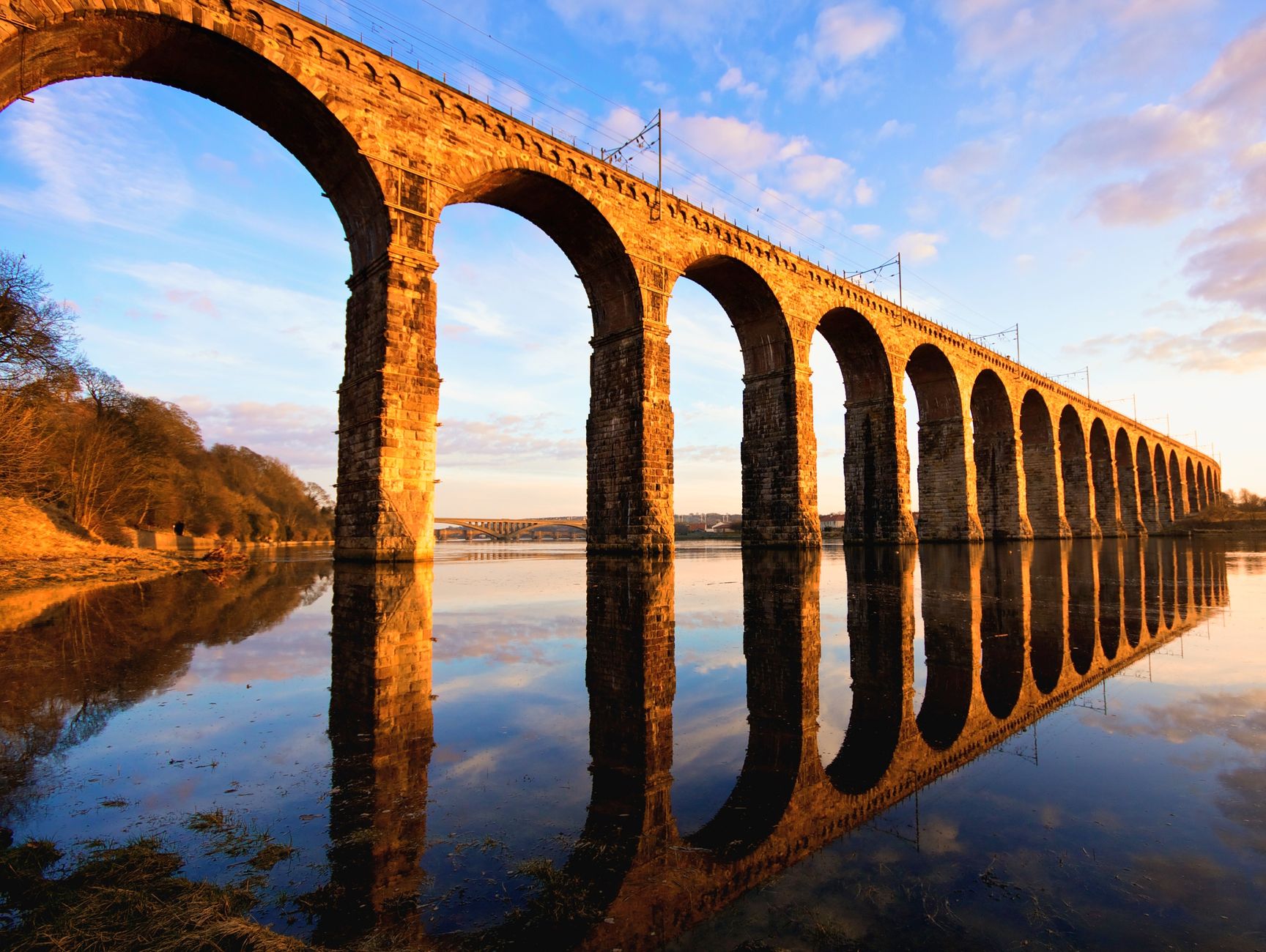
England's northernmost town sits on a bluff above the River Tweed, 42 km north of Bamburgh. Berwick changed hands between England and Scotland thirteen times before finally becoming English in 1482, and the Elizabethan town walls built in the 1560s reflect the serious investment made in holding it. The walls are among the most complete for their period in Europe: nearly 2.5 km of ramparts, bastions and gateways that can be walked in about an hour and give clear views across the Tweed estuary and out to sea.
The Royal Border Bridge, a 28-arch railway viaduct designed by Robert Stephenson and opened by Queen Victoria in 1850, is best seen from the riverbank at dusk when the stone arches reflect in the water. The town centre has an 18th-century Barracks managed by English Heritage, good independent cafes near the town hall, and far fewer visitors than its historical interest warrants.
The A1 south from Berwick to Newcastle covers 108 km in around 75 minutes through rolling Northumbrian farmland. The Tyne Bridge comes back into view as the city approaches, completing the loop.
May, June and September offer the best balance: long days, reasonable accommodation prices and smaller crowds at the main sites. July and August bring more visitors, particularly to Bamburgh and Alnwick, but the coast never becomes as congested as better-known English seaside spots. Holy Island is visited year-round, though the priory is perhaps most atmospheric outside peak summer. The AD122 Hadrian's Wall bus only runs April to October, so a winter visit to the Wall requires a car and careful planning.
Newcastle upon Tyne is on the East Coast Main Line with direct trains from London (approximately 2 hours 50 minutes), Edinburgh (approximately 1 hour 30 minutes) and Leeds. The full loop requires a car, either brought from home or hired in Newcastle. There are no motorway sections once you leave the city outskirts.
Fuel stations are plentiful throughout the route. Holy Island has one small shop; bring food and water for the day. Bamburgh itself has limited evening dining options; Seahouses, 5 km to the south, has more choice. Alnwick has good parking near the castle. In Newcastle, use the Metro rather than attempting to park near the Quayside.
Ready to plan it in detail? Use the full Northumberland Castles and Coast route below to see every stop, driving leg and overnight on the interactive map.
An 8-day loop through England's oldest national park, taking in Chatsworth House, the caves of Castleton, Kinder Scout moorland and the Victorian spa town of Buxton.
The full route — stops, maps, and driving times — is on Routebook by Kington.
An 8-day loop from Newcastle upon Tyne connecting Hadrian's Wall, Alnwick Castle, the coast at Bamburgh and Holy Island, and Berwick-upon-Tweed, returning via the A1.
 Routebookby Routebook